
The Smarter Way to Build Spectacle - LED Wall vs Projection Mapping vs Volumetric Lighting Toronto
- Mike Dunn

- Mar 12
- 6 min read
Updated: Mar 13
LED Wall vs Projection Mapping vs Volumetric Lighting in Toronto: Choose by Workflow, Not Trend
When people plan a visually ambitious event or production, they often start with the wrong question: what looks the coolest?
The better question is: what will actually work best for the way the event or shoot needs to be built, tested, operated, and captured? That is where many productions lose time and money.
We believe visual design should never be separated from technical workflow. Whether you are planning a brand activation, concert-style event, content shoot, launch, or immersive experience in Toronto, the right visual system is not always the trendiest one. It is the one that fits the space, the schedule, the content pipeline, and the production reality.
For many teams, the conversation eventually becomes LED wall vs projection mapping vs volumetric lighting in Toronto, and which system actually supports the workflow of the production. This is the practical difference between LED walls, projection mapping, and volumetric lighting.
The Short Answer
If you want a quick rule of thumb, choose LED walls when you need brightness, control, repeatability, and strong on-camera results. Choose projection mapping when you want transformation, surface-based storytelling, or a more architectural visual effect. Choose volumetric lighting when atmosphere, movement, mood, and physical depth matter more than screen-based content.
In many of the best productions, the answer is not one or the other. It is a smart combination. But before combining systems, it helps to understand what each one is best at.
LED Walls: Best For Control, Brightness, And Content-driven Environments


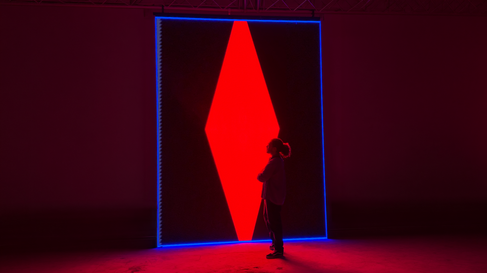
LED walls are often the strongest choice when content is central to the experience. They are especially useful for brand launches, product reveals, DJ and performance visuals, filmed interviews, branded content, presentations, and events where camera capture and social content matter.
The biggest advantage of LED is control. Brightness is reliable, playback is consistent, and visuals hold up well on camera. When content needs to change quickly or run on precise cues, LED is usually easier to manage than more experimental display approaches.
LED walls make the most sense when you need a clean, high-impact focal point, when visuals are heavily designed in advance, when your show requires precision, or when you want a modern premium look that works both live and on camera.
They are less ideal when the budget is too tight for the scale you want, when the concept needs to wrap across irregular surfaces, or when the goal is environmental transformation rather than a strong screen-based centerpiece.
A lot of teams choose LED because it feels like the safe premium option. Sometimes that is exactly right. But not every concept needs a giant digital rectangle. The real question is whether the visual system supports the experience, not just whether it looks expensive.
Projection Mapping: Best For Transformation And Spatial Storytelling

Projection mapping is powerful when you want the room itself to become part of the visual idea.
Instead of placing content on a screen, projection mapping uses media and light to reshape walls, scenic builds, objects, or architectural surfaces. This can create a far more immersive feeling when the concept is designed properly from the start.
Projection mapping can work especially well for immersive brand activations, art-driven events, fashion presentations, scenic reveals, installations with custom builds, and story-led experiences where the room needs to evolve over time.
It makes the most sense when the concept is tied directly to the physical space and when you want to animate surfaces rather than simply display content. It is also a strong choice when the goal is to make the room feel embedded in the storytelling.
That said, projection mapping is usually less forgiving than LED. It often needs more calibration, more technical planning, and tighter alignment during setup. It also becomes less effective if the room has too much ambient light or if the schedule leaves little time for testing. It is not the right choice just because it feels creative. It is the right choice when the concept depends on spatial transformation.
Volumetric Lighting: Best For Mood, Depth, And Cinematic Atmosphere

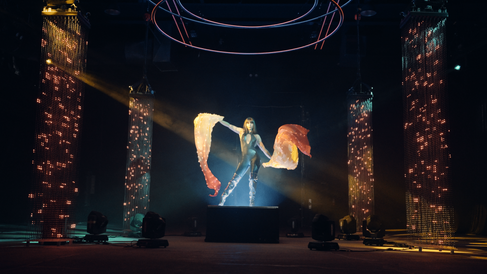


Volumetric lighting is different from both LED walls and projection mapping because it is not mainly about displaying content. It is about shaping the air, the depth, and the emotional tone of the room.
When done well, volumetric lighting can make a space feel cinematic, dramatic, futuristic, intimate, or alive. It is especially powerful for music-driven environments, performance spaces, art events, branded content capture, and any setup where atmosphere is part of the value.
This approach makes the most sense when you want visible beams, texture, depth, and movement; when the event should feel immersive without relying entirely on screens; or when the room needs to photograph and film with more dimensionality.
Volumetric lighting is less ideal when the client expects literal branded messaging or graphic content to be displayed. It can also fall flat if the space is too bright, if haze use is not planned properly, or if lighting cues are treated as an afterthought instead of part of the overall technical design.
Volumetric lighting is often underestimated because it is less obvious in a mood board than a giant LED wall. But in real life, it can do something extremely valuable: it makes the experience feel physical. That matters for audience memory, and it matters for camera.
The Mistake Most Teams Make: Choosing By Trend Instead Of Workflow
The wrong system can create expensive friction.
This usually happens when teams choose a visual approach based on what they saw on Instagram, what feels premium in theory, what a client casually mentioned, or what looked good at a completely different venue.
But visual technology is never just a design choice. It affects load-in time, rigging needs, content preparation, playback systems, rehearsal length, operator requirements, troubleshooting risk, and how well the final result works on camera.
That is why the best choice is usually the one that works best with the full production workflow.
How To Actually Choose The Right System
A practical way to decide is to ask a few simple questions.
First, is the priority content, transformation, or atmosphere? If the answer is content, LED is often strongest. If the answer is transformation of surfaces, projection mapping may be the better fit. If the answer is mood, immersion, and depth, volumetric lighting may do more for the experience.
Second, what needs to happen during load-in and rehearsal? Some systems are more forgiving than others. LED can be highly efficient when properly planned. Projection mapping usually needs more alignment and calibration time. Volumetric lighting may require more cueing, haze balancing, and camera testing. If the schedule is tight, the most technically demanding option may not be the smartest one.
Third, is this being designed for the room, the audience, or the camera? Sometimes the live audience is the priority. Sometimes the event is really a content capture opportunity. Sometimes it needs to do both. That distinction matters because a setup that feels amazing in person may not always translate on camera, and a setup that looks sharp on camera may not always feel immersive in the room.
Fourth, how early is the content and technical team involved? LED content, mapped content, and lighting design all benefit from pre-visualization, cue planning, and technical coordination before install day. The later these decisions happen, the more risk gets introduced.
Finally, ask whether one system actually solves the brief or whether it is being forced. If you need one clean, reliable visual centerpiece, LED might solve it. If you need the room itself to come alive, projection may solve it. If you need emotional texture and dimensionality, lighting may solve it. If you are trying to force one tool to do everything, the concept may need to be rethought.
Why Workflow-First Planning Saves Budget
The most expensive production mistake is not always picking the wrong gear. It is picking the right-looking idea with the wrong execution plan.
Budget gets wasted when content is not prepared in the correct format, when visual systems are added too late, when rehearsal is treated as optional, when load-in time is underestimated, or when the venue and production team are not aligned early enough.
A workflow-first process protects the creative idea. It helps the team understand what should be pre-built, what needs testing in advance, what is better handled in pre-visualization, what requires extra technical time, and what is realistic within the available budget.
That is where a production-capable venue becomes a major advantage.
Why This Matters In Toronto
Toronto has no shortage of event spaces. What is harder to find is a venue that understands how production decisions affect the final result.
When a venue is treated only as a room rental, the technical thinking often gets pushed too late. That is when schedules compress, compromises happen, and production value drops.
For events and shoots involving immersive visuals, lighting, content systems, or technical complexity, the strongest outcomes usually come from choosing a space that can support planning early, not just host the final day.
At Demo Room, that means thinking beyond square footage. It means considering the full experience: creative intent, technical feasibility, pre-visualization, load-in logic, rehearsal flow, visual impact, and capture potential.
That is how stronger productions get built.
Final Thought
LED walls, projection mapping, and volumetric lighting can all be powerful. None of them are automatically the best choice.
The best choice is the one that fits the workflow, supports the concept, respects the schedule, and helps the experience land properly in the room and on camera.
Trend-driven decisions may look exciting in a pitch. Workflow-driven decisions are what make productions actually work.
Comments